Voice is the most natural way humans communicate. Now, with AI chat voice, businesses can tap into that natural channel and turn it into a powerful, always-on customer experience engine. Using AI to enhance customer service operations, companies can replace long wait times and tedious typing with seamless, spoken interactions. This approach shows clearly how AI boosts customer support efficiency, letting customers simply speak, be understood, and get instant, helpful responses.
Beyond customer service, AI chat voice is part of a larger ecosystem of artificial intelligence innovations powered by cloud computing, advanced machine learning and modern computer technology. By leveraging cloud-based AI platforms, businesses can scale voice interactions, manage large volumes of customer queries, and deploy intelligent virtual assistants without heavy on-premises infrastructure. In marketing, AI-driven tools analyze consumer data, automate content creation, and optimize digital advertising campaigns for better engagement, allowing brands to deliver personalized messaging across websites, social media, and email campaigns. Similarly, financial institutions are integrating AI to automate loan approvals, detect fraudulent transactions, analyze market trends, and provide instant support through conversational voice assistants. Even in broader business technology, AI chat voice connects seamlessly with customer relationship management systems, analytics platforms, and omnichannel communication tools, ensuring every interaction is efficient, informed, and consistent.
By combining cloud computing, AI-powered analytics, digital marketing automation, and intelligent financial solutions, organizations can transform how they engage with customers, reduce operational costs, and gain competitive advantages in a rapidly evolving digital landscape. This convergence highlights the potential of AI chat voice as not just a tool for support, but a gateway to smarter, data-driven, and human-centered business experiences.
This guide walks through what AI chat voice is, how it works, and the most compelling ways you can put it to work in your business for higher satisfaction, lower costs, and faster growth.
Top AI Chat Voice Contact Center Solutions in 2025
AI chat voice is revolutionizing the way businesses handle customer support. From intelligent virtual agents to cloud-based platforms, companies are adopting AI-powered contact center solutions to improve customer satisfaction, reduce wait times, and streamline operations. Here are the top 10 AI chat voice contact center solutions available today.
1. Bright Pattern – AI Contact Center Solutions
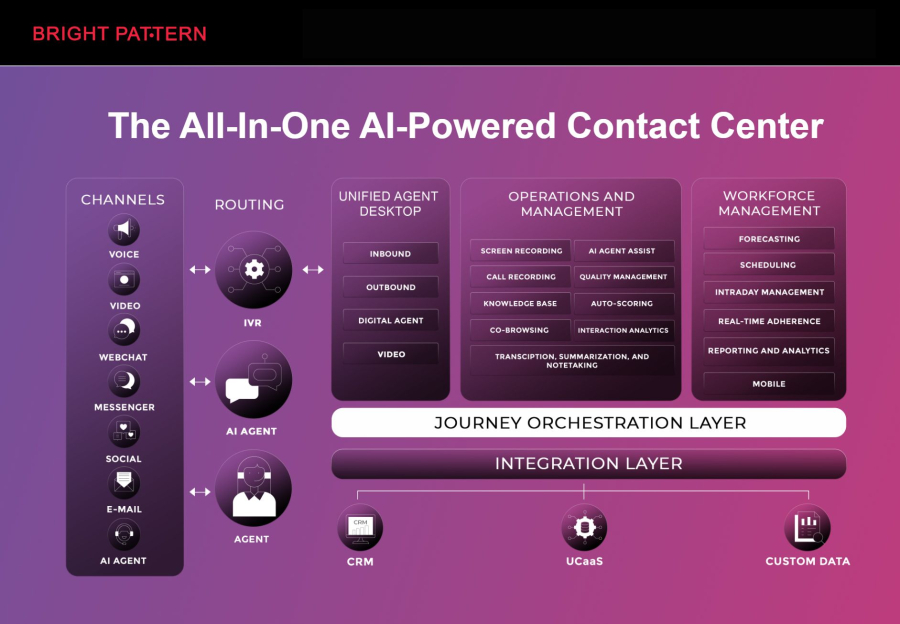
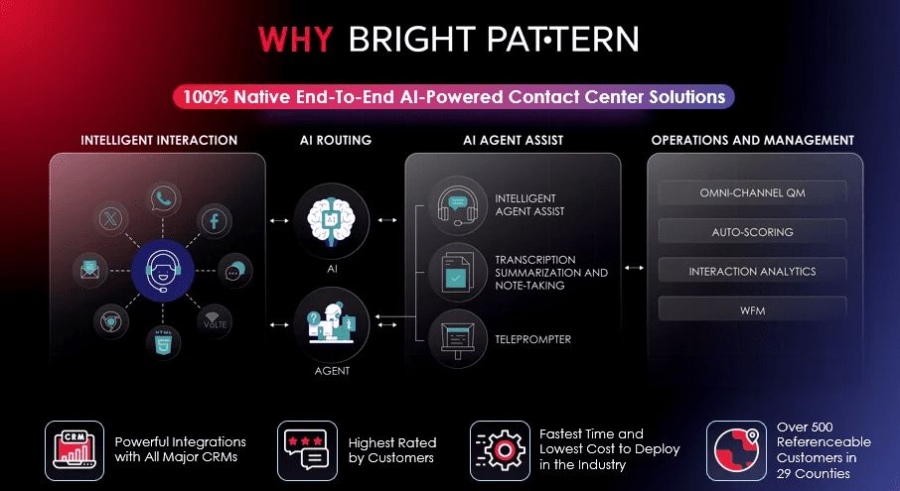
Bright Pattern leads the industry in AI-driven contact center solutions, offering a robust platform that combines AI chat voice, omnichannel communication, and advanced analytics. Designed for businesses of all sizes, Bright Pattern’s solutions help teams deliver faster, more personalized support without increasing costs.
Key Features:
- AI chat voice integration for natural spoken interactions
- Omnichannel support across phone, chat, email, and social media
- Cloud-based infrastructure for scalability and flexibility
- Real-time analytics and AI-powered agent assistance
- Intelligent routing to ensure customers reach the right agent every time
Bright Pattern also enables businesses to integrate AI with CRM systems, marketing automation, and analytics platforms, making it a full-spectrum solution for modern contact centers. Companies using Bright Pattern can scale their operations quickly, provide consistent customer experiences, and leverage AI insights to improve both agent performance and customer satisfaction.
2. Genesys Cloud CX
Genesys Cloud CX provides AI-powered call center and customer experience solutions, including predictive routing, virtual assistants, and AI chat voice features to streamline support across channels.
3. Five9 Intelligent Cloud Contact Center
Five9 offers AI-driven call center software with speech analytics, AI chat voice, and automation tools to improve efficiency and reduce agent workload.
4. NICE CXone
NICE CXone delivers AI-enhanced customer service solutions with omnichannel routing, real-time analytics, and AI-powered chat and voice capabilities for seamless support.
5. Cisco Webex Contact Center
Cisco Webex combines cloud-based contact center technology with AI chat voice tools to enable smart routing, analytics, and virtual assistant features for enhanced customer engagement.
6. Talkdesk CX Cloud
Talkdesk CX Cloud offers an AI-first platform for customer support, integrating AI chat voice, automated workflows, and data-driven insights to optimize call center performance.
7. Avaya OneCloud CCaaS
Avaya OneCloud CCaaS provides intelligent contact center solutions, including AI chat voice, omnichannel support, and automated agent assistance for improved response times.
8. 8x8 Contact Center
8x8 delivers AI-enabled contact center solutions with voice recognition, automated workflows, and real-time analytics, helping businesses enhance customer experiences.
9. RingCentral Contact Center
RingCentral combines AI chat voice, multichannel support, and cloud-based contact center tools to help organizations manage high volumes of customer interactions efficiently.
10. Aspect Via CCaaS
Aspect Via CCaaS provides cloud contact center solutions with AI chat voice integration, intelligent routing, and workforce optimization features for modern support teams.
What Is AI Chat Voice?
AI chat voiceis a conversational system that lets users interact with an AI assistant using spoken language. It combines three core capabilities:
- Speech recognitionto turn spoken words into text.
- Natural language understanding and generationto interpret intent and craft responses.
- Text-to-speechto convert the AI's response back into a natural-sounding voice.
From the user's perspective, it feels like talking to a helpful, knowledgeable agent. They ask questions out loud, clarify, interrupt, and follow up just as they would with a human conversation partner.
Why AI Chat Voice Matters Right Now
Businesses are embracing AI chat voice because it solves multiple pain points at once while unlocking new opportunities. Some of the most important reasons include:
- People prefer talking over typingfor many tasks, especially on mobile, while driving, or when multitasking.
- Voice is fasterthan typing for most users, reducing friction and abandonment.
- Automation is essentialas support volumes rise and hiring becomes more competitive.
- Customer expectations are higher than everfor 24/7, instant, personalized service.
AI chat voice sits at the intersection of all four trends, making it a strategic advantage for organizations that adopt it early and thoughtfully.
How AI Chat Voice Works in Practice
Behind the scenes, AI chat voice relies on a sequence of specialized components working together in milliseconds. Understanding this flow helps you design better experiences and set the right expectations.
1. Capturing the User's Voice
The conversation starts when a user speaks into a microphone on a phone, laptop, smart speaker, car infotainment system, or kiosk. The AI system captures that audio signal and prepares it for recognition.
2. Automatic Speech Recognition (ASR)
Next, the audio is processed by aspeech recognitionmodel. This component:
- Filters noise and detects when the user is speaking.
- Breaks down the sound into phonemes and words.
- Outputs the most likely sequence of words the user said.
Modern ASR can handle a wide range of accents, speaking speeds, and environments, especially when it is tuned for a specific domain like banking, healthcare, or retail.
3. Natural Language Understanding and Decision Logic
Once the words are transcribed, the system usesnatural language processing(NLP) to interpret what the user actually wants. This step involves:
- Extracting the user'sintent(for example, "check order status" or "reset password").
- Identifying keyentities(such as order number, product name, date, or location).
- Consultingbusiness rules and knowledge basesto decide how to respond.
In many systems, a conversational AI model orchestrates the dialog, asking clarifying questions, handling follow-up queries, and maintaining context from one turn to the next.
4. Response Generation
After determining the best action, the AI composes a response. This could involve:
- Retrieving data, such as account details, booking information, or delivery status.
- Triggering workflows, like updating a reservation or submitting a support ticket.
- Generating a natural, conversational explanation tailored to the user's request.
The system aims to keep responses concise, clear, and aligned with your brand voice while ensuring the user gets exactly what they need.
5. Text-to-Speech (TTS)
The final step is turning that response intonatural-sounding speech. Modern TTS can produce lifelike voices with appropriate pacing, pronunciation, and even subtle intonation patterns. This makes the interaction feel far more human and less robotic.
Key Benefits of AI Chat Voice for Businesses
Organizations that adopt AI chat voice consistently report gains across customer experience, operational efficiency, and revenue. Here are the most impactful benefits.
1. 24/7, Instant Service Without Staffing Nightmares
With AI chat voice, your customers can get help at any time of day, without waiting in a queue or navigating complex phone menus. This has several advantages:
- Always availablesupport, even outside traditional business hours.
- No hold musicand minimal friction, which reduces frustration.
- Predictable service levelsduring peak periods or seasonal spikes.
Instead of scrambling to add temporary staff, you can rely on a consistent, scalable AI layer to smooth out demand.
2. Lower Operational Costs With Higher Coverage
AI chat voice allows you to automate a large portion of routine, repetitive calls. This directly reduces support costs while freeing up your human team to provide deeper, higher-value assistance.
- Handlehigh-volume, simple requestssuch as order tracking, appointment confirmations, and basic troubleshooting.
- Let human agents focus oncomplex, emotionally sensitive, or high-value interactions.
- Scale naturally with demand without proportional increases in headcount.
Many organizations find that AI can resolve a large share of calls end-to-end, while still handing off gracefully to humans when needed.
3. Faster, More Convenient Customer Journeys
Voice is often thefastestandleast effortfulchannel for customers. They can ask follow-up questions, clarify details, and shift directions mid-conversation, which is harder in rigid menu-based systems.
- Reduced task timeas users simply say what they need instead of navigating menus.
- Less abandonmentbecause the conversation feels natural and responsive.
- Higher satisfactionwhen customers can accomplish goals in one seamless interaction.
By eliminating friction across frequent tasks, AI chat voice can significantly raise your overall customer experience scores.
4. Personalized, Consistent Experiences
AI chat voice can pull real-time data from your systems to personalize interactions at scale. Unlike human agents, it never forgets a preference and always follows your latest guidelines.
- Recognize returning customers and greet them by name where appropriate.
- Tailor responses based onpurchase history, preferences, or loyalty status.
- Applyconsistent policies, compliance rules, and brand language across all calls.
The result is a service experience that feels both personal and reliably on-brand, across millions of interactions.
5. New Revenue and Upsell Opportunities
Because AI chat voice is available around the clock, it can capture sales that might otherwise be lost. When designed strategically, it can also surface relevant offers during support interactions.
- Turn after-hours inquiries intocompleted orders and bookings.
- Offercontextual cross-sells and upsellsthat align with the customer's current request.
- Guide prospects throughproduct discovery and comparisonusing conversational questions.
Instead of viewing support as a pure cost center, AI chat voice lets you transform it into a revenue-positive touchpoint.
6. Actionable Insights From Every Conversation
Every voice interaction becomes a source of insight. AI systems can analyze aggregated transcripts to reveal patterns you might otherwise miss.
- Identify themost common reasons customers contact you.
- Spotconfusing product features or policiesthat generate unnecessary calls.
- Tracksentiment trendsand recurring friction points over time.
These insights can feed back into product development, marketing messaging, and service design, creating a powerful improvement loop.
Powerful Use Cases for AI Chat Voice
AI chat voice is highly flexible and can be adapted across industries and functions. Below are some of the most effective and high-impact applications.
Customer Support and Service
This is often the starting point for AI chat voice implementations because the impact is immediate and measurable.
- AnswerFAQsabout policies, hours, and common troubleshooting steps.
- Provideorder statusand delivery updates using real-time data.
- Help customersreset passwordsor access self-service tools.
- Route complex cases to thebest-qualified human agentwith context attached.
Sales and Pre-Sales Support
AI chat voice can act as a conversational guide for prospects exploring products, services, or pricing.
- Answer detailed product questions in afriendly, non-technical way.
- Qualify leads by askingtargeted discovery questions.
- Schedulecallbacks or demoswith sales representatives.
- Capture key information needed toprepare tailored proposals.
Appointment and Booking Management
From healthcare to hospitality and professional services, scheduling is a natural fit for AI chat voice.
- Allow customers tobook, reschedule, or cancel appointmentsvia voice.
- Send voice reminders or confirmations triggered by the AI conversation itself.
- Handlehigh-volume seasonal bookingswithout overwhelming human staff.
Internal Support and IT Helpdesks
AI chat voice is not just for external customers. Internal teams can benefit too.
- Help employeesreset passwordsor gain access to systems.
- Provide quick answers aboutHR policies, benefits, or procedures.
- Guide staff throughstep-by-step troubleshootingfor devices and software.
This reduces internal wait times and ensures smoother day-to-day operations.
Voice Assistants in Cars, Kiosks, and Smart Devices
AI chat voice also powers conversational experiences far beyond traditional call centers.
- In-vehicle assistantsthat help with navigation, calls, and infotainment controls.
- Retail or hotel kiosksthat handle check-ins, information requests, or wayfinding.
- Smart devicesthat respond to voice commands for configuration, support, and education.
Designing a Great AI Chat Voice Experience
Success with AI chat voice is not just about technology. It is also about thoughtful experience design. A well-designed system feels intuitive, helpful, and human-friendly.
1. Start With High-Value Journeys
Rather than trying to automate everything at once, focus on a few high-impact scenarios. Ideal starting points often share three traits:
- High volumeof calls or interactions.
- Clear, structured processesthat are easy to automate.
- Meaningful valuewhen automated, such as cost savings or better experience.
By launching with targeted journeys, you demonstrate quick wins and build internal momentum.
2. Use Plain, Natural Language
Your AI chat voice should converse the way your customers do. That means:
- Avoiding dense jargon or internal acronyms.
- Usingshort, clear sentencesand asking one question at a time.
- Mirroring the user's vocabulary where appropriate.
The goal is to make the conversation feel effortless, not like navigating a script.
3. Design for Clarification and Error Recovery
Even with powerful models, misunderstandings can happen. A strong AI chat voice experience anticipates this and recovers gracefully.
- Offer simplerephrasing promptssuch as "Did you mean" style confirmations.
- Allow users tointerrupt or correctthe AI naturally.
- Provide a clear, easy path to ahuman agentwhen needed.
Customers are forgiving when they see that the system is trying to help them reach a solution, even if it needs a second attempt.
4. Match Brand Voice and Personality
Your AI chat voice is often the first "personality" new customers meet. Investing in tone and style pays off.
- Define your desiredtone(for example, professional, friendly, or playful).
- Choose or design avoice profilethat aligns with your brand and audience.
- Ensure responses areempatheticin stressful scenarios like delays or account issues.
Consistency between your AI voice experience and your other channels builds trust and recognition.
5. Continuously Improve Using Data
AI chat voice systems become more effective over time when you feed learning back into the loop.
- Reviewconversation analyticsto identify where users drop off or request human help.
- Expand training data to covernew phrases, accents, and edge cases.
- Refinebusiness rules and flowsas products and policies evolve.
Ongoing optimization turns a good AI experience into a truly exceptional one.
Comparing AI Chat Voice to Traditional Call Automation
It is helpful to contrast AI chat voice with older technologies like interactive voice response (IVR) systems. While both involve automation over the phone, the experience is very different.
|
Aspect |
Traditional IVR |
AI Chat Voice |
|
Interaction style |
Menu-based, choose by number |
Free-form, natural conversation |
|
Flexibility |
Rigid flows, limited paths |
Handles many intents and follow-ups |
|
Personalization |
Minimal, mostly rule-based |
Dynamic, data-driven personalization |
|
User effort |
High; long menus and waiting |
Low; speak directly to the system |
|
Continuous learning |
Static unless manually updated |
Improves through data and retraining |
This shift from rigid menus to fluid conversations is what makes AI chat voice so compelling and user-friendly.
Getting Started With AI Chat Voice
Putting AI chat voice into action does not have to be overwhelming. A structured approach helps you move quickly while managing risk.
1. Clarify Your Goals
Begin by defining the outcomes you want to achieve. Common goals include:
- Reducingaverage handling timefor common queries.
- Boostingfirst-contact resolutionrates.
- Improvingcustomer satisfaction scoreson the phone channel.
- Extendingsupport hourswithout expanding headcount.
Clear goals help you choose the right use cases and measure success.
2. Map Your Top Call Drivers
Analyze recent call logs or support tickets to find your most frequent conversation types. For each, consider:
- How often the call type occurs.
- How structured or predictable the interaction is.
- Whether clear data sources exist to support automation.
This mapping quickly reveals where AI chat voice can deliver the strongest early impact.
3. Design the Conversation Flows
For your chosen use cases, outline simple conversation flows. Think in terms of how real people talk, not how your internal processes are documented.
- Write example dialogs using actual customer phrases.
- Plan for alternate paths when users skip ahead or change topics.
- Define clearhandoff pointsto human agents when needed.
These flows guide both training and testing, ensuring your AI aligns with real-world usage.
4. Pilot, Measure, and Iterate
Launch an initial pilot with a subset of callers or a limited set of intents. Then:
- Monitorcompletion ratesand customer satisfaction on those calls.
- Collect internal feedback from agents who receive AI handoffs.
- Make targeted adjustments to prompts, flows, and routing.
A data-driven pilot offers both quick wins and valuable learning before broader rollout.
Future Trends in AI Chat Voice
The AI chat voice landscape is evolving rapidly. Several trends are enhancing what is possible and how natural these experiences feel.
More Expressive and Multilingual Voices
Advances in speech synthesis are making AI voices more expressive, with better control over tone, emphasis, and speaking style. At the same time, multilingual capabilities are expanding, allowing your AI to serve diverse customer bases seamlessly.
Deeper Integration Across Channels
Voice experiences are increasingly connected with chat, email, and web interactions. Customers can start a task through AI chat voice and continue it later via text, with full context preserved.
Richer Personalization With Contextual Awareness
Future AI chat voice systems will leverage more contextual signals, such as past interactions, current location (when appropriate), and real-time behavior, to fine-tune responses and anticipate needs.
AI Chat Voice as a Strategic Advantage
AI chat voice is far more than a new feature on your phone system. It is a strategic capability that can transform how customers perceive and engage with your brand.
- It turns voice, the most human communication channel, into ascalable, intelligent interface.
- It dramatically reduces friction across the customer journey, from discovery to ongoing support.
- It creates a continuous stream ofinsightsthat fuel smarter business decisions.
Organizations that embrace AI chat voice now position themselves to deliver faster, friendlier, and more personalized service at a scale that manual operations alone cannot match.
If you are exploring ways to elevate customer experience, optimize operations, and unlock new revenue, AI chat voice is one of the most powerful levers you can pull today
